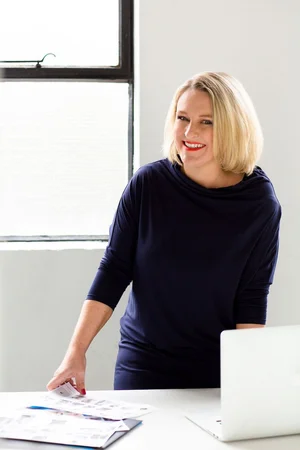
14 Years of Branding Women Entrepreneurs: What I Know Now That I Didn't Know Then.
The patterns, the turning points, and the thing that changes everything.
I started Flourish in 2011.
I was good at a lot of things. I was doing most of them, brand design, yes, but also online business management, systems and integrations, course creation, copywriting, web development, the lot. If a woman building a business online needed something done, I could probably do it. I was saying yes to almost everything, staying very busy, and operating under the confident assumption that range was an asset.
(It was. Until it very much wasn't. This is also known as a lesson you only need to learn once, ideally, but may need to learn several times because you are a person who runs a business.)
Fourteen years is a long time to work in any industry. Long enough to see patterns repeat. Long enough to watch things you were certain about turn out to be wrong. Long enough to notice the thing you kept coming back to, the thing that made you forget everything else was happening, and to finally, finally, accept that this was the only thing you were ever really meant to be doing.
This is not a neat success story. It is an honest one.
The first thing I got wrong.
I thought the problem was a skills problem.
When women came to me with brand work, I understood it as a technical challenge: the logo needs work, the website needs a redesign, the colours are not cohesive, the typography is inconsistent. Fix the technical problems, produce something that looks professional, hand it over.
The technical work was good. I am confident in that. But something kept happening that I could not account for in technical terms: the work would land beautifully on the page and the client would still feel vaguely disconnected from it. She would use it. She would be professionally satisfied. She would not feel proud.
I watched this enough times to know it was not a design failure. The work was objectively good. Something else was wrong.
What was wrong. And I did not have the language for it yet, was brand-fit. The brand reflected a competent, professional version of the client rather than the actual one. It looked right. It did not feel right. And the difference between looking right and feeling right is, it turns out, the entire difference between a brand that works and one that just exists.
The thing that changed everything.
Before I found the framework, I was already getting strong results, by asking really good questions and genuinely listening to what women wanted for their lives. Online business felt like this extraordinary opportunity for women to earn on their own terms, and it was an exciting time to be working in it. The instinct was right. I just did not yet have the structure to match.
I came to Brand Archetypes around 2017, through the work of Margaret Hartwell and Joshua C. Chen, and through my own growing conviction that there had to be a structural answer to the fit problem.
The first time I applied the framework properly, built a brand fully around a client's archetype combination, from the ground up, instead of designing something that looked nice and hoping it resonated. The client cried.
(This sounds dramatic. It happens regularly. We keep tissues. We don't comment. We let the moment be what it is.)
She said: that is me. That is actually me on a page.
Not: I love it. Not: it is beautiful. Those things too. But the first thing, the thing she could not contain, was recognition. She saw herself in the brand for the first time.
That was the turning point. I stopped treating brand design as a technical problem with an aesthetic solution and started treating it as an identity problem with both a structural and an emotional answer.
The framework, archetypes as the foundational layer beneath every brand decision, became the Flourish methodology. Every client since has gone through this process first. And the work since has been categorically different. Not just technically better. Actually transformative.
The difference between a brand that looks right and a brand that feels right is the entire difference between a brand you tolerate and a brand you believe in enough to build a business around.
The pattern I kept seeing. Over and over. Fourteen years of it.
Every woman is different. Their archetypes are different, their industries are different, their histories are different. But the pattern underneath all of it has been remarkably consistent:
Accomplished woman. Genuinely extraordinary at what she does. Has built a successful business. Has a brand that is, by all objective measures, fine.
Fine.
And she is apologising for it, quietly, every time she sends someone to her website. She is hoping they do not look too closely. She is pre-explaining herself in conversations. The website does not quite show what I do, but... She is procrastinating on visibility because the brand does not feel like a fair representation of who she actually is.
The brand exists. The woman is hiding behind it.
(Not hiding from laziness or cowardice, hiding because the brand genuinely does not reflect her, and visibility feels like an exposure of the gap between the two.)
I have watched this hundreds of times. The most extraordinary women, with the most extraordinary practices, operating behind brands that were built to be inoffensive rather than to represent them. Choosing invisibility not because they do not want to be seen, but because the version of them that is visible is not really them.
This is what I mean when I talk about the visibility gap. It is not a marketing problem. It is a fit problem. And it has a structural solution.
What I got wrong about the conditioning.
For most of the early years, I treated the brand work as separate from the confidence work. The brand was my department. The confidence was the client's personal journey, something being worked on separately, something that would improve once the brand was better.
What I have learned. And this took embarrassingly long, in retrospect, is that they are not separate. The brand is part of the confidence work. The right brand does not just look better: it creates a new relationship to visibility for the woman wearing it.
Because what most of my clients have been navigating, underneath the brand conversation, is the same thing: decades of conditioning that said be brilliant but palatable, be excellent but not intimidating, be visible but not in a way that makes anyone uncomfortable.
A brand built on the palatable version of them reinforces that conditioning. It confirms: this is as much as you are allowed to be. It makes the gap between the performed self and the real one bigger, not smaller. And every piece of content they create from behind that brand is navigating that gap.
A brand built on the real one, on the archetype, on the actual personality, on the genuine aesthetic register, does something different. It gives the real self somewhere to stand. It says: this is you, all of you, and it is exactly right. And visibility from behind that brand is a completely different act.
I have had clients tell me they feel differently pitching for work after the rebrand. That they price differently. That they stopped underselling. That they said yes to opportunities they would have quietly declined before.
I do not take credit for that. The brand did not create those qualities. They were always there. The brand just stopped obscuring them.
FOURTEEN YEARS OF WATCHING THIS HAPPEN AND IT STILL GETS ME. EVERY SINGLE TIME.
What I know about the market now that I didn't know then.
In 2011, the problem was scarcity. There was not enough good brand design for women entrepreneurs. The bar was low. Get the work right and stand out.
The market in 2025 is a different animal entirely.
The volume is extraordinary, content, brands, coaches, consultants, designers, AI-generated everything. The noise is deafening. It is constant, relentless, and increasingly difficult to cut through.
And the audience has changed in response to it. The woman I am trying to reach has developed, through sheer exposure, a very precise and very rapid ability to detect what is real and what is not. She cannot always articulate it. But she feels it immediately. The brand that was made with genuine attention versus the one that was generated in thirty seconds. The voice that actually belongs to someone versus the voice that was workshopped to death.
What this means for brand work now is that the stakes of getting it right have never been higher. A fine brand in 2011 was fine. A fine brand in 2025 is invisible.
The market is hungry for human. Genuinely, specifically, unmistakably human. The brand that gets that right, that produces a person rather than a persona, a real voice rather than a calibrated one, has an advantage that no volume of generated content can touch.
This is why the archetype work matters more now than it ever has. Not as a positioning strategy. As an answer to what the market is actually asking for.
Why I stopped doing everything else.
A few years ago, I made the decision to stop offering services outside of brand and website work. OBM, integrations, course builds, systems. I was still capable of all of it. Some of it I am excellent at.
But none of it made me forget to eat. (And I forget to eat when I'm genuinely absorbed in something. It's the only reliable signal I have.)
Brand work. Specifically, the archetype-led brand and website work that has been the core of Flourish, is the only thing I have ever done in my professional life that consistently produces that quality of absorption. The state where the time disappears. Where I am three hours in and it feels like twenty minutes. Where the outcome surprises me in the best way even though I made it.
(If you know that state, you know there is nothing like it. If you are currently doing work that does not produce it, I understand completely why you are reading a blog post about Brand Archetypes at this hour.)
The decision to only do the thing that produces that state was both the most obvious decision and the hardest one. Because capability is not the same as calling. And the things I was capable of were generating income and filling time and keeping me sufficiently occupied that it took years to admit I was diluting the one thing I was actually extraordinary at.
Choosing only the brand work freed something up. In me, and in the work itself.
Capability is not calling. The things you can do well are not necessarily the things you should be building your business around. Your archetype will tell you the difference, if you let it.
What Flourish looks like now.
The transition to brand-only work started three years ago, and it did not start elegantly. It started because my nervous system stopped tolerating the alternative.
The stress of running Flourish as it was, taking on everything, managing launches, holding the complexity of other people's businesses alongside my own, combined with what was happening in my personal life, took a direct toll on my body. I developed a number of illnesses that took years to fully recover from. The business did not do that to me alone. But it was honest with me about what it could not keep being.
Launch management was the loudest signal. The work itself was not the problem. I was good at it. But my body made clear, in the way bodies eventually do when you have ignored every subtler message, that this particular version of the work was not for me.
So I listened. Later than I should have, but I listened. 😳
The shift to brand-only work is still happening. It is not a completed chapter, it is a current one. But the direction has been clear for three years, and the further along that path I go, the more certain I am that it is right.
The other thing that has become clear, through the archetype work itself, is that Flourish has its own evolution to honour.
For years, the brand ran on Explorer energy. Curious, ranging, always adding, always expanding. That energy built something real. It also, eventually, built something that was pulling in too many directions at once.
The work of the last few years has been a shift toward Lover. Depth over breadth. Devoted attention over broad capability. Two clients a month, fully held, rather than many clients managed from a distance. Intimacy as a business model, not just a value.
The Explorer got Flourish started. The Lover is where the work has always wanted to go.
Moving forward we will work with approx two clients a month.
Complete, devoted, full-attention work. The kind you can feel in the outcome. The kind where the client says 'that's actually me' and means it in the way that matters.
The Spark is the brand identity intensive. Two weeks, archetype to logo suite to brand guidelines, all of it rooted in who you actually are.
The Fire is the full brand and website build.
The Glow is the VIP design day for the repeat clients who needs a focused intensive on a specific element.
And our Squarespace and Canva templates are for the woman who wants to start beautifully right now, before she is ready for the full build.
Everything starts with the archetype. Everything ends with something the client is proud to be visible in.
That is the work. That is what fourteen years of getting it wrong and then getting it right has produced.
It is not for everyone. It is for the woman who knows her brand is not doing justice to her work and is ready to change that. The woman who has been apologising for her website for three years. The woman who is extraordinary at what she does and is only visible to a fraction of the people she should be reaching.
If that is you. I would love to talk.
A Discovery Call is a conversation, not a sales pitch. There’s no fast action bonus 🤮.
We figure out together what your brand needs and whether Flourish is the right place to build it. If it is, brilliant. If it is not, I will tell you honestly and point you somewhere better.
(Fourteen years in. I have strong opinions about where to point people. I am not above using them.)